Pages

Showing posts with label remembrance. Show all posts

Sunday, 28 October 2018

Changing Impressions: Remembrance Workshops at Cumbria's Museum of Military Life

Objects and samples ready for the workshop

Earlier in the Summer I wrote a couple of posts about projects I've been involved in connected to the centenary of the end of the First World War. One of the projects I've been involved with was designing and delivering a drop in workshop (two actually) for Cumbria's Museum of Military Life as part of their Remembrance 100 programme.

Stitching

Making a rubbing

Adding stitching

In all honesty drop in workshops are not my favourite; the activity needs to be accessible and achievable in a very short time frame but should also be able to be extended if visitors want to stay, you never know how many people you're going to get and a lot like busses participants tend to either not turn up at all or all come at once! However, they are a great way of getting people in to museums and offer an easy way for people to participate which I do think is a really good thing.

Exploring colour

Rubbings and stitching

Adding stitching

Memory and how it changes over time is a theme I'm currently exploring in my own work so I was interested in creating a workshop that looked quite broadly at remembrance; what it means to remember and how that changes. (I wrote a bit about this on my post about the Remembrance 100 exhibition if you're interested to read more.) I'd also been asked to give the workshop a textiles focus, which was good for me as of course I love working with textiles.

Getting involved

Getting involved

Getting involved

I decided to create a workshop called 'Changing Impressions.' Using fabric crayons and cotton fabric I encouraged participants to make a rubbing of an object, creating an impression of it. If they wanted to they could then further embellish their rubbing with stitch. The idea was that by taking a rubbing from the object you would create an impression of it; it's from the object and bears a resemblance to it but it's not the same in the same way that our memories of things are not the same as the actual things (or events.) Further embellishment further changes the memory of the object imprinted on the cloth, just as each time we revisit a memory it subtly changes.

Workshop results

Workshop results

Workshop results

I really enjoyed running the sessions, both were well attended and what I loved was seeing participants, particularly the children, become very engaged in what they were doing and focusing on the process. In our increasingly fast paced world I think it's increasingly important to find time to stop, slow down and properly engage with an activity, especially one that uses the hands. I think I created several converts to hand embroidery, more than one child was heard to ask if they could go and buy threads to do some sewing at home. It was also lovely to see family groups sit and work together, supporting and encouraging each other and creating memories as well as exploring them.

Workshop results


Monday, 22 October 2018

Rust and Red: Adventures in Colour and Remembering

Memory Cloth (For Cathy)
Rust dyed fabrics, hand embroidery, feathers and found objects
2018

Over the course of this year I've been involved in a number of projects connected with the centenary of the end of the First World War and Remembrance. When I first began getting involved with these projects I wasn't really sure how my work would connect; military history isn't really my thing. However, the more I thought about it the more I realised that actually there are a lot of connections, particularly with the remembrance element of the centenary.

Memory Cloth (For Cathy)
Detail

Memory Cloth (For Cathy)
Detail

Memory Cloth (For Cathy)
Detail

Memory is one of the themes that I'm interested in exploring in my work, in particular the way that it changes over time and the way that objects, especially textiles, hold memories. One of the reasons I like to work with natural dyes is that they are a way of preserving a memory of that resource in cloth and I also like the way that the colours can change and shift over time, they remain beautiful but they change subtly and slowly just like our memories.

Memory Cloth (For Cathy)
Detail

Memory Cloth (For Cathy)
Detail

Early on in the year I began work on a piece in memory of a particular person; Cathy. A member of Cumberland Embroiderers Guild and a very talented stitcher Cathy was always so enthusiastic and encouraging and always wanted to hear about my projects. When she died her son asked me to help sort through her extensive stash, dividing it up amongst the charities I work for. I kept a few of her unfinished samples and the needles and pins that were too rusty to use. I wanted to create a piece of work that would celebrate her life and provide a way of remembering her.

Work in progress on Memory Cloth

I used the rusty pins and needles and a small pair of her rusty scissors to dye and print some fabric. I then assembled this dyed fabric along with some of her unfinished samples, feathers and various other bits and pieces. I joined these pieces with lines of stitch, representing her journeys through life and connecting all the different elements together.

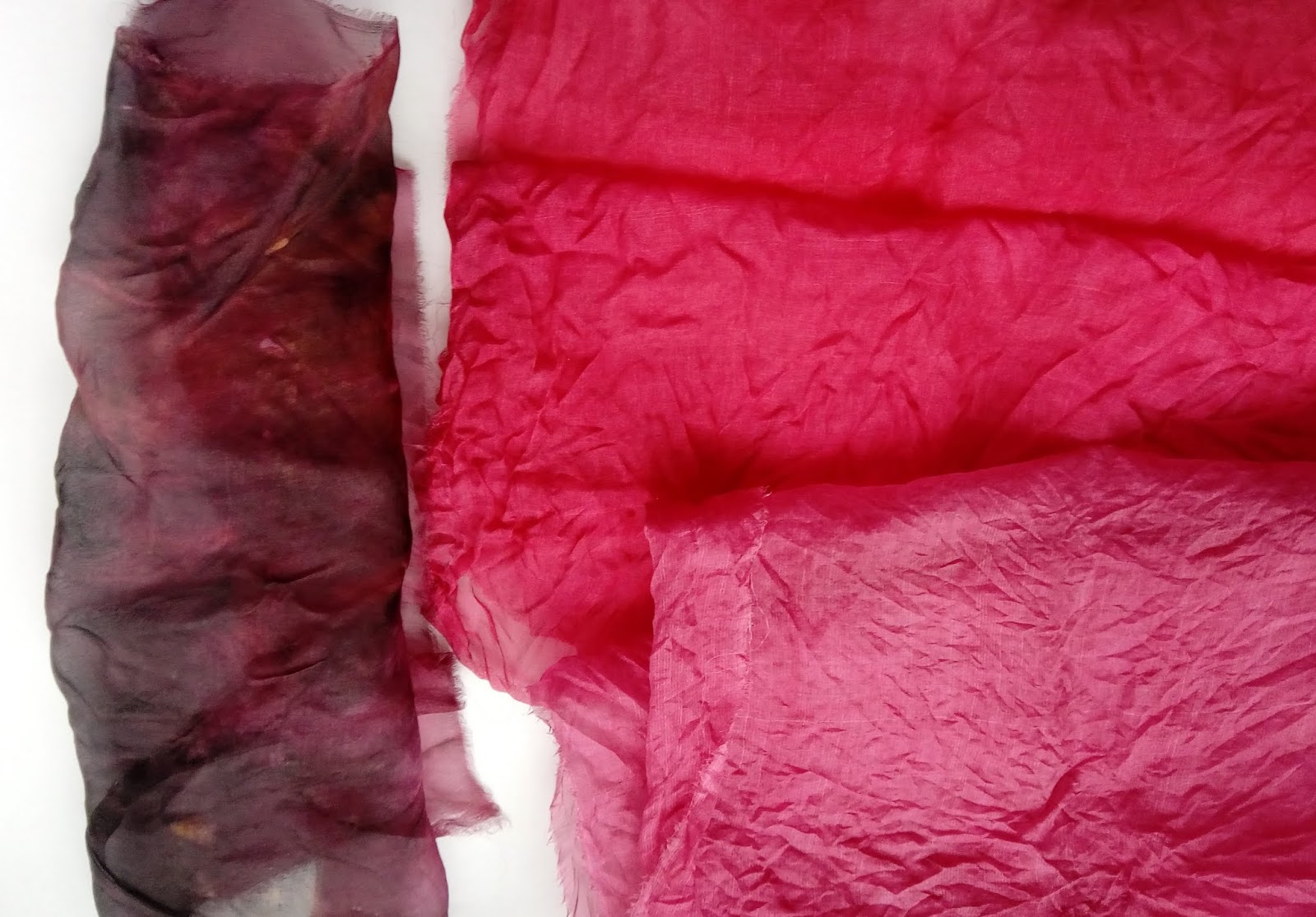
Silk dyed with cochineal

Wool, cotton and linen dyed with cochineal

Linen, cotton, wool and silk dyed with cochineal

The finished piece was exhibited at Farfield Mill as part of the Nostalgia exhibition earlier this year and then again as part of the Cumberland Branch of the Embroiderers Guild exhibition at Tullie House in September. I like that the piece could be both personal (as it was when shown in September) or more general (as it was in May) but either way I found people could connect with it and find their own stories, memories and interpretations within it.

Flow: Red
Naturally dyed fabrics, feathers, sequins and hand embroidery
2018

Every two years Cumberland Branch of the Embroiderers Guild holds an exhibition (as mentioned above.) This year our theme was Red and the Chairman's challenge was Poppies, to tie in with the centenary and remembrance events. Although I use touches of red in my work it's not a colour I'm very confident with, I lean more towards cooler colours like blues and greens. However, I wanted to create a piece for the exhibition and, handily, earlier in the year I'd been doing some dyeing with cochineal so had quite a few bits of naturally dyed fabric ready to use.

Flow: Red (detail)

Flow: Red (detail)

Flow: Red (detail)

Inspired by the pieces I'd made for Remembrance100 at Cumbria's Museum of Military Life and the piece I made in memory of Cathy I decided to make one of my mini banners, as I call them. I wanted red to be the main theme but I also added touches of gold to hint at the preciousness of life but also as a nod to military regalia and medals. I also wanted the piece to reference poppies and remembrance so I incorporated black and red sequins. As always I included feathers as in my work I use them to represent us and because I wanted this piece to be part of my 'Flow' series, which explores the flow and change of life and memory.

Flow: Red (detail)

Flow: Red (detail)

Although quite different to my other pieces I like this piece, it is much bolder and less subtle and it was interesting working with such a strong colour. I found it very challenging as often it felt too much but I'm happy with how the different elements have eventually come together.


Tuesday, 26 June 2018

Remembrance 100 at Cumbria's Museum of Military Life

Flow: Memory
Naturally dyed fabrics, feathers, shells, beads and hand embroidery. 2018

With 2018 marking 100 years since the end of the First World War there are, unsurprisingly, a lot of exhibitions and events exploring remembrance. One of these is 'Remembrance100' at Cumbria's Museum of Military Life. As WWI starts to slide out of living memory it is an important anniversary to mark and is an interesting time to look at how the way we remember changes.

Remembrance100 Exhibition

My work (top left)

Remembrance100 is an open art exhibition curated by Jamie Barnes. I think having an open exhibition to explore this diverse area is a really good idea as remembrance is something that belongs to us all, it's great to have an opportunity anyone can apply to so that a range of interpretations can be seen. I submitted and had accepted one of my small textile banners. This piece is entitled 'Flow: Memory' and is part of an ongoing series looking at the concept of flow and part of a wider body of work exploring memory.

Flow: Memory (detail)

I am fascinated by memory and the way how we remember can change. We have a tendency to think of memories as fixed and unchanging but this is not the case. Our memories, both personally and our memories (or remembrance) as a society, are constantly changing and evolving. They are affected by the physical and biological changes that occur within our own bodies as we age and they are affected by the changes that the society we live in goes through. Our experiences and constantly changing emotions also change our memories. Memories are fluid, ephemeral things that ebb and flow like the tides; each time a little different.

Flow: Memory (detail)

This idea of change, ebb and flow is something I'm really interested in exploring in my work. By creating a piece of work about memory I'm trying to fix in a tangible way something that is intangible, I hope by using layers of naturally dyed and sheer materials I can capture an element of this or at least provide something to get people thinking about memory and the nature of remembering.

Flow: Memory (detail)

The exhibition is on until 2nd September and features work by lots of excellent artists, both professional and amateur. If you go before 8th July you'll also be able to see the incredible 'Weeping Window' ceramic poppy installation at the castle.

Weeping Window

Weeping Window

Weeping window


Wednesday, 6 April 2016

Somme 100: Poppy Patterns

Work in progress on patterns

I love the diversity of my work, I love the different opportunities that come my way and the chance to work with lots of different organisations on different projects. I have just finished designing two patterns for Cumbria's Museum of Military Life, which records the history of Cumbria's County Infantry Regiment. The patterns I have designed are a knitted poppy and a crocheted poppy.

Working on the train: Trying different shapes

The patterns are available on the museums website and are part of a larger project commemorating the centenary of the Battle of the Somme. The aim of this part of the project is to create a knitted or crocheted poppy for each soldier of the Border Regiment who died during the Somme. The poppies will be displayed from the windows of the museum building, each month more poppies will be added to the display, corresponding with the number of men who died that month in the Somme 100 years ago.

Knitted Poppy

Detail

In total the museum are aiming to make 1700 poppies. It is very difficult to know exactly how many people died and when they died. A soldier may have been injured during the battle and died from his wounds many weeks or even months later. There were also of course other Cumbrian's not in the Border regiment who died in the Somme but in order for the project to work there has to be some parameters. I hope that rather than getting caught up in agonising over exact numbers people will recognise that a huge number of individuals lost their lives and each of those lives was significant and this project commemorates them all.

Crocheted Poppy

Creating these patterns was surprisingly challenging, not because they were difficult to make but because part of the brief was to make the patterns accessible to beginners. I spent a lot of time stitching and un-stitching trying to get a shape that worked but that would be easy to re-create. Hopefully I've managed that but we will see! As part of my efforts to keep the pattern simple I chose to use the stylised shape of the poppy used by the British Legion.

If you'd like to get involved with the project please contact the museum, there are a lot of poppies to make!