Pages

Showing posts with label flags. Show all posts

Thursday, 26 November 2015

The Seven Stories: Exhibition

Seven Stories Exhibition: Carlisle Library

Since January Prism Arts's artists, including myself, have been working in schools and with various community groups on a big project called 'The Seven Stories.' The project is a collaboration between Prism Arts and Cumbria Library Service and stems from a project we ran a couple of years ago.

Installing the work on the hanging grid

Last week we were in Carlisle Library installing the exhibition from their hanging grid. It was a challenging and tiring day but well worth it as the finished exhibition looks great. Later in the week we had an official opening ceremony attended by various dignitaries and, most importantly, many of the participants. Seeing how pleased the participants were with the finished work made all the hours of preparation and sewing worth while!

Flags by St. Bede's students

Flags by St. Bede's students

Flags by St. Bede's students

For this project I worked with a Year 4 class at St. Bede's Primary School and an art group at Carleton Day Centre. I really enjoyed working with both groups and the work they produced is fantastic. I've also really enjoyed seeing the work from the other groups. I particularly like the exploding seed packets made by the group of stroke survivors and the birds and bird cage made by the Creative Conversations group.

The Book of Carlisle by Carleton Day Centre art group

The Book of Carlisle by Carleton Day Centre art group

The school children I worked with produced a series of flags inspired by a 700 year old book held in Carlisle Library. The flags weave in and out of the other exhibits, representing the idea of journeys and the twists of a tale and tying all the pieces together.

Looking up from the ground floor

Looking up from the ground floor

The group from Carleton originally wanted to make a time capsule but as we worked their ideas evolved and we created 'The Book of Carlisle.' This is a large book with each page exploring something the group members liked about Carlisle, including the dragon from the city arms, socialising with friends and the wildlife of the area.

Seen from the balcony

Seen from the balcony

The work will be hanging in the library until March at which point more work, made in response to the exhibition, will be on show. Like all good stories there's always a little bit more to come...

Sunday, 5 July 2015

Seven Stories: St. Bede's School #4 Bookmaking

A stack of books and collagraph plates

Another instalment in my series of posts about Prism Arts/Cumbria Library service Seven Stories project...

Working into our book pages

Working into our book pages

Working into our book pages

Having finished all the flags for our installation I wanted to spend my last session with the class working on something they could take home. Throughout the project they've been asking if they can keep the work we've done even though they're excited about it going into the library so for a while I'd been thinking about what we could do. As we have been working on this project the children have generated a lot of supporting material, such as designs, collages and practice prints. So, I thought that making a book would be a good way of collecting all the work they've done together and giving them something they can take home and show to their family and friends. As the project is a collaboration with the library and the classes starting point was a 700 year old book in Carlisle Library there is also a nice link there too.

Taking rubbings from a collagraph plate

Working into a rubbing

Working into our book pages

As I'd hoped the session provided a good opportunity to look back over all the things we'd tried over the project and it was great to hear what they'd enjoyed and what they'd found difficult. Unfortunately the class teacher was off work but in a way this was good as it gave the pupils the opportunity to tell a different member of staff what they'd done and how. I think they were quite surprised with how much work they's actually done! As well as the collagraph prints we had collages, designs, felt samples and stencilled prints.

A medium sized dragon

A selection of pages

During the day I encouraged the pupils to work back into their pages, particularly the collagraph prints. We used pastels, watercolour pencils and coloured pencils to add colour to the prints and did some rubbings from the collagraph plates as well. Some of the pupils even made extra pages, developing the designs and ideas we'd worked on previously. I also asked them to write a little bit about the pages, what they did, how and why. Some of the pupils really got into this side of things and others not so much! Some of the books even feature glossaries, contents pages and acknowledgements. I find it very rewarding when I take an idea in and the students really run with it, developing and expanding on it.

A finished book

Finished books

A collaged page

For the construction of the books I wanted to keep it simple because I was working with the whole class so I hole-punched all the pages and got the students to choose a ribbon to thread the pages together with. By the end of the day everyone had a finished book; a record of what they'd learnt and something to show to others. I think they were pleased as they kept asking to take them home, I said they had to wait until the end of term!

Book pages

A finished book

A design page with  written explanation

I've really enjoyed working with this class and I will miss my Wednesday's with them. I was really touched as throughout the day the students kept bringing me little drawings they's done for me. Because the project is a long running one we've been able to get to know each other well and developed good relationships, this has allowed the pupils to improve not only their practical skills but their self belief as well. I've seen their skills and confidence grow and it is a really satisfying thing to know that I've been part of that. It will be great to see the work up in the library in November. Which reminds me, I had better finishing sewing all the flags together...

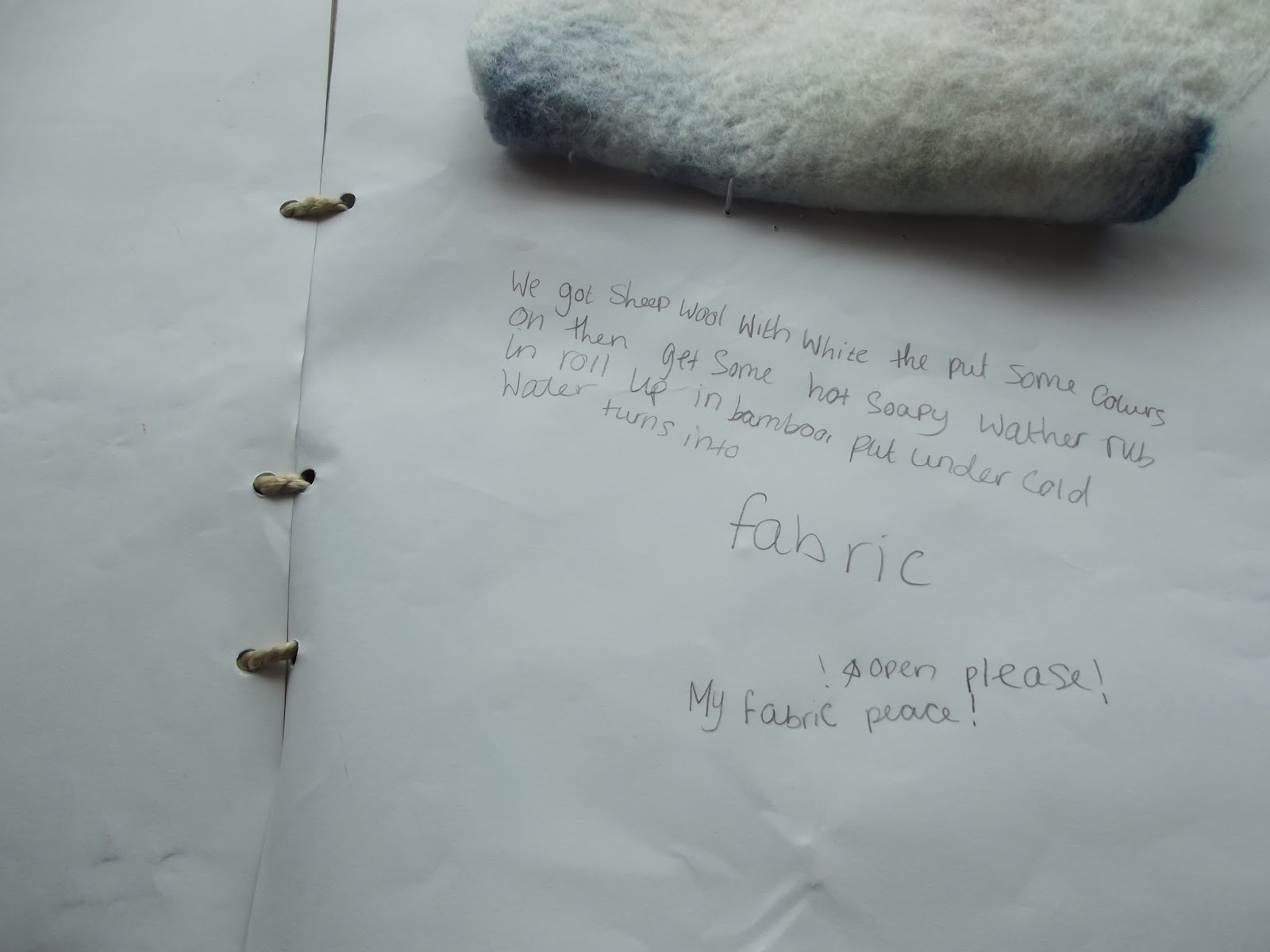
Page with felt sample...

...and description

Sunday, 21 June 2015

Seven Stories: St. Bede's School #3 Fabric Collage and Stencils

Rainforest Fabric Collage: Selecting materials

I've been working with a local school for the past few months on a big project from Prism Arts and Cumbria Library Service called Seven Stories. Recently I've been catching up on my blogging about this project, this post is about the collaged and stencilled flags we've made.

Using paper templates to cut out shapes

Using paper templates to cut out shapes

Using paper templates to cut out shapes

As I mentioned in my previous post about this project I wanted to give the students the chance to try a range of different techniques so having made our collagraph printed flags and felt flags and because I knew the pupils were really good at paper collage I thought fabric collage would be a good technique to try.

Arranging the fabric collage

Arranging the fabric collage

Arranging the fabric collage

I really like working with collage, both paper and fabric, as it is a very accessible way of working and allows for a lot of experimentation. It is also a good opportunity to get to handle different materials and to explore colour and texture. Fabric collage also allowed the pupils to have a go at pinning and tacking, skills they may not necessarily get to develop otherwise.

Work in progress

Pinning the pieces down

Arranging and pinning

One of the things I've been working on with the students is getting them to work through a process; a lot of modern life is so fast and is all about instant gratification I think it's good to do things that take time and that you have to work out. I think it helps the students understand that the more time and energy you invest in the work the better the outcome. I also think that some of the slower, more labour intensive techniques give them chance to really think about what they're doing and so gives them the opportunity to develop their analytical and problem solving skills.

Pinning

Tacking

Tacking

Making both the fabric collaged and stencilled flags involved quite long processes and as you would expect each student found certain parts of the processes easier than others. This class has been good at concentrating on their task from the start but I have noticed that over the course of the project the pupils ability to stick at things has improved and really importantly their confidence in their own abilities has grown. Because there is only one of me and 28 of them I obviously can't give them all my undivided attention all of the time, this has meant that rather than always waiting for me to say 'yes, that's right' the students have become more confident in trusting their own judgement and just going for it.

Taking pride in their work

Work in progress

Abstract arrangement focusing on colour

Another reason I think their confidence has grown is that all the work they've produced is their own, by which I mean there has been very limited input from me beyond demonstrating and explaining processes. When a student asks me what to do I tend to turn the question round and ask them what they think they should do. We can then have a little discussion about different options but I let them decide how to proceed and get them to do it. I want to support the students to create their own work, try new things and learn by doing rather than having me do things for them.

Paper stencils

Paper stencils

Paper stencils

The class really enjoyed working on the collaged flags. As always they had some great ideas and produced beautiful work. Similar to the felt flags the collaged flags were based on the different landscapes of the stories. We started by making templates to cut out shapes related to each landscape as I wanted to encourage them to try a more abstract approach rather than a pictorial approach. We then had great fun selecting and cutting fabric shapes which were then pinned and then tacked in place. I then took the flags home to sew on the sewing machine.

Using the stencils

Using the stencils

Using the stencils

Building on the idea of shapes for each landscape we took a similar approach to making the stencilled flags. Making stencils can be quite difficult, it can be very hard to visualise which bits to cut out and which to leave to create the image you want so I was impressed with the stencils the class produced. As with a lot of the techniques we've been working with simple shapes often work better than complicated ones and some of the pupils whose work is small scale and intricate found this quite hard. However, everyone ended up with a usable stencil and was able to make a flag, as before some really beautiful work was produced and this activity was a really good example of how the students have learnt to persevere and keep going until they get the result they want.

Flags hung up to dry

Stencilled owls

Stencilled snowflakes

So, we now have collagraphed flags, felt flags, collaged flags and stencilled flags. These will be sewn together in pairs to make double sided flags which can then be sewn onto ribbon to make a string of flags ready to be installed in the library in November. Best get stitching...